
 Email-Id :
 Contact Us : 0172-521-4040 (India), +91-172-521-4040 (Outside India)
Description
Introduction
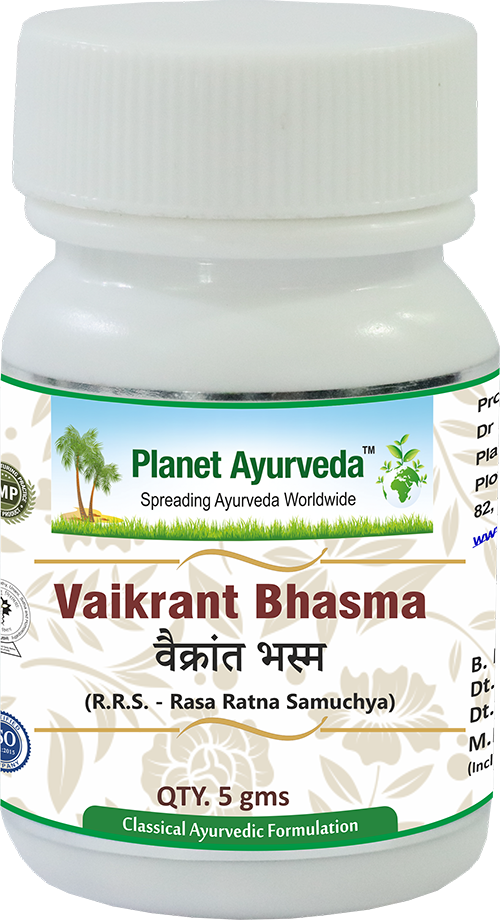
Vaikrant Bhasma is a classical mineral-based Ayurvedic preparation described in Rasashastra (the Ayurvedic science of minerals, metals, and pharmaceutical processing). Vaikranta is traditionally classified under the Mahārasa group in important Rasashastra texts, including Rasa Ratna Samuccaya. It is commonly identified with tourmaline, although its mineral identification has varied across historical sources. The preparation involves specific pharmaceutical procedures, including Shodhana (purification) and Marana (incineration), to obtain the final Bhasma (processed mineral preparation). Classical Ayurvedic literature describes Vaikranta in relation to Rasayana (rejuvenative support), Balya (strength-promoting properties), and Vrishya (reproductive health-supporting properties). Its traditional applications and qualities are discussed in texts such as Rasa Ratna Samuccaya and Rasa Tarangini.
वैक्रान्तो वज्रसदृशो देहलोहकरो मतः ।
विषघ्नो रसराजश्च ज्वरकुष्ठक्षयप्रणुत् ॥
(Rasa Ratna Samuccaya, Chapter 2/64)
Vaikrant is described as being similar to a diamond and capable of making the body as strong as iron. It is traditionally regarded as counteracting the effects of poisons and alleviating fever, skin diseases, and wasting disorders. It is also known as the King of Minerals in Ayurvedic alchemical literature.
Ingredients of Vaikrant Bhasma
1. Vaikrant (Tourmaline)
Vaikrant is the principal mineral component of Vaikrant Bhasma and holds significance in Rasashastra (Ayurvedic mineral science). In traditional Ayurvedic literature, it is associated with Rasayana (rejuvenative properties), Balya (strength-promoting properties), and Vrishya (reproductive health support). Its classical attributes have contributed to its traditional use in formulations intended to support vitality and general well-being. Vaikrant represents the core therapeutic identity of this mineral-based preparation within the Ayurvedic tradition.
2. Kulathi (Horse Gram, Macrotyloma uniflorum)
Kulathi is a legume recognised in Ayurveda for its Katu (pungent) and Kashaya (astringent) taste profile, along with its traditional association with Kapha-reducing properties. It is valued in Ayurvedic dietary practice for supporting digestion and maintaining metabolic balance. Its traditional qualities make it a notable ingredient in mineral-processing systems, where plant-derived substances have an important place in classical pharmaceutical practices. Kulathi also contributes to the broader Ayurvedic understanding of combining plant and mineral substances in specialised formulations.
3. Gandhak (Sulphur)
Gandhak is an important substance in Rasashastra and is traditionally described for its role in several mineral and herbo-mineral formulations. Properly processed Gandhak is associated with traditional Ayurvedic applications related to skin health, metabolic functions, and overall wellness. Its significance in Vaikranta Bhasma lies in its complementary role alongside the principal mineral component. In classical Ayurvedic pharmaceutical practice, Gandhak is valued for its distinctive properties and its place in specialised formulations.
4. Lemon Juice (Nimbu Swarasa, Citrus limon)
Nimbu Swarasa is valued in Ayurveda for its Amla (sour) taste and its traditional association with Deepana (supporting digestive fire) and Pachana (supporting digestion). It contains naturally occurring citric acid and other organic compounds that give it distinctive chemical properties. In Ayurvedic pharmaceutical traditions, lemon juice serves as an important plant-derived medium in selected mineral formulations. Its inclusion reflects the traditional use of natural acidic substances in specialised Ayurvedic preparations.
Method of Preparation
कुलत्थक्वाथसंस्विन्नो वैक्रान्तः परिशुध्यति ।
म्रियतेऽष्टपुटैर्गन्धनिम्बुकद्रवसंयुतः ॥
(Rasa Ratna Samuccaya, Chapter 2/64)
Vaikrant is processed with Kulathi (horse gram) decoction and dried. It is then subjected to eight cycles of calcination with Gandhak (sulphur) and Nimbu Swarasa (lemon juice) to obtain the Bhasma.
Special Note
Vaikrant can be prepared by another method also which is as follows:
वैक्रान्तकाः स्युस्त्रिदिनं विशुद्धाः संस्वेदिताः क्षारपटूनि दत्त्वा ।
अम्लेषु मूत्रेषु कुलत्थरम्भानीरेऽथवा कोद्रववारिपक्वाः ॥
(Rasa Ratna Samuccaya, Chapter 2/63)>
All types of Vaikrant are purified by subjecting them to Swedana (heating in a Dolayantra) for three days in Kanji (fermented sour gruel), Gomutra (cow’s urine), Kulattha decoction (horse gram), or banana juice, with the addition of alkaline substances. Alternatively, Vaikrant can also be purified by boiling it in water prepared from Kodrava (kodo millet).
Indications of Vaikrant Bhasma
- Rajayakshma (wasting disorder)
- Jara (ageing)
- Panduroga (anaemia)
- Arsha (haemorrhoids)
- Shwasa (breathing disorders)
- Kasa (cough)
- Grahani Roga (digestive and intestinal disorders)
- Urahkshata (chest injuries)
- Mukha Roga (oral diseases)
- Bala Vardhana (promotion of physical strength)
Benefits of Vaikrant Bhasma
Rasayana (Rejuvenative Support)
Vaikrant Bhasma is traditionally associated with Rasayana properties, which are valued in Ayurveda for supporting vitality, maintaining physiological balance, and promoting overall well-being.
Ojas Support (Vitality and Resilience)
In traditional Ayurvedic practice, Vaikrant is associated with maintaining the body’s vitality and resilience, which are important aspects of strength and general health.
Dhatu Poshana (Nourishment of Body Tissues)
Vaikrant is traditionally discussed in relation to supporting the body’s tissue systems (Dhatus), which contribute to structural integrity, nourishment, and physiological functioning.
Balya (Strength-Promoting Properties)
Classical Ayurvedic descriptions associate Vaikrant with supporting physical strength and stamina, contributing to its traditional role in restorative formulations.
Vrishya (Reproductive Health Support)
Vaikrant is traditionally described as having Vrishya properties, linking it with reproductive vitality and its use in specialised Ayurvedic formulations.
Yogavahi (Formulation-Enhancing Role)
In Rasashastra, processed minerals are incorporated into carefully designed formulations with other ingredients. Vaikrant’s role within these combinations is understood in the context of traditional pharmaceutical principles.
Dhatu Sthirikarana (Support for Tissue Stability)
From the Ayurvedic perspective, Vaikrant is associated with maintaining tissue integrity and supporting the body’s overall functional balance.
Applied Aspect
भस्मत्वं समुपागतो विकृतको हेम्ना मृतेनान्वितः पादांशेन कणाज्यवेल्लसहितो गुञ्जामितः सेवितः ।
यक्ष्माणं जरणं च पाण्डुगुदजं श्वासं च कासामयं दुष्टां च ग्रहणीमुरःक्षतमुखान् रोगाञ्जयेद् देहकृत् ॥
(Rasa Ratna Samuccaya, Chapter 2/70)
When 125 mg (one Ratti) of Vaikranta Bhasma is mixed with one-fourth of its quantity of Suvarna Bhasma (gold ash), along with Vidanga, Pippali (long pepper), and ghee, its classical indications include Rajayakshma (wasting disorder), ageing, Panduroga (anaemia), Arsha (haemorrhoids), Shwasa (breathing disorders), Kasa (cough), impaired digestive function (Grahani disorders), chest injuries, and oral diseases. The formulation is also traditionally described as promoting physical strength.
सूतभस्मार्धसंयुक्तं नीलवैक्रान्तभस्मकम् ।
मृताभ्रसत्त्वमुभयोस्तुलितं परिमर्दितम् ॥
क्षौद्राज्यसंयुतं प्रातर्गुञ्जामात्रं निषेवितम् ।
निहन्ति सकलान् रोगान् दुर्जयानन्यभेषजैः ।
त्रिः सप्तदिवसैर्नृणां गङ्गाम्भ इव पातकम् ॥
(Rasa Ratna Samuccaya, Chapter 2/71-72)
Ras Sindoor (mercurial preparation) in half the quantity, one part of blue-coloured Vaikranta Bhasma, and an equal quantity of purified Abhraka (mica) essence are triturated together. Honey and ghee are then added to the mixture. The text describes taking 125 mg (one Ratti or one Gunja) every morning for 21 days, claiming that even diseases considered incurable by other medicines can be eliminated, just as the waters of the Ganga are believed to wash away sins.
Dosage
The recommended dosage is 62.5 mg once or twice daily, before or after meals, as advised by a qualified Ayurvedic physician.
Adjuvant
Honey (Madhu), Cow Ghee (Go-Ghrita)
Conclusion
Vaikranta Bhasma holds a distinctive place in Rasashastra (Ayurvedic mineral science) because of its traditional pharmaceutical significance and specialised applications. Its preparation reflects the classical Ayurvedic principles of mineral processing, in which careful purification and transformation are essential aspects of formulation development. Traditionally associated with Rasayana (rejuvenative support) and Balya (strength-promoting properties), Vaikranta Bhasma is recognised for its place in specialised Ayurvedic preparations. Its historical importance highlights the depth of classical Ayurvedic pharmaceutical knowledge and the traditional approach to supporting vitality, strength, and overall well-being.


Reviews
There are no reviews yet.