
 Email-Id :
  Contact Us : 0172-521-4040 (India), +91-172-521-4040 (Outside India)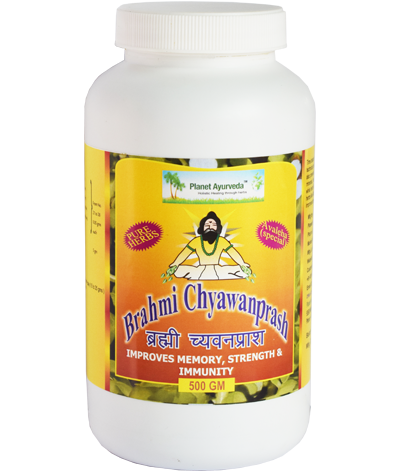
Description
What is Brahmi Chyawanprash?
Brahmi Chyawanprash is the beneficial preparation known as rasayana in the field of Ayurvedic medicine. This is called rasayana because of their capacity to communicate the superior rasa as well as other dhatus. Brahmi Chyawanprash is an Ayurvedic supplement made with various pure and natural herbal extracts and minerals and rich in Vitamin C. The use of it helps in avoiding many diseases through its immunomodulatry effects and rejuvenation properties.
There is story behind the preparation of Chyawanprash which clearly explains its benefits and potential. There was a Rishi named Chyawan (Cyavana) who was very old, but he became youthful through taking this preparation. By taking this preparation he realized that his elderly, old and weakened body became young.
What are the medicinal properties of Brahmi Chyawanprash ?
- Rejuvenating
- Enhances the physical performance
- Helpful in cold and cough
- Diuretic
- Beneficial in Infections – throat, chest
- Antioxidant
- Cardio protective
- Helpful in restoring health
- Prevents skin diseases
- Useful in Gout
- Increases hemoglobin levels
- Improves memory
- Increases the immunity and appetite
- Asthma
- Blood disorders
- Anorexia nervosa
- Indigestion
- Lung injury
- Tuberculosis (TB)
- Male infertility
- General debility
- Nutritional deficiency disorders
- Insomnia (Sleeplessness)
- Debility after any disease
- Dementia
Herbs used in the preparation of Brahmi Chyawanprash
All the herbs used in the preparation of it has specific qualities and benefits. When these herbs are mixed together than the qualities work collectively which makes the preparation to be one of the best health supporter.
Kwath Dravya
| S. No. | Herb Used | Latin Name | Part Used |
| 1 | Bilva | Aegle marmelos | Bark |
| 2 | Agnimantha | Premna mucronata | Bark |
| 3 | Shyonak | Oroxylum indicum | Bark |
| 4 | Kashmarya | Gmelina arborea | Bark |
| 5 | Patala | Stereospermum suaveolens | Bark |
| 6 | Shalaparni | Desmodium gangeticum | Whole Plant |
| 7 | Prishnaparni | Uraria picta | Whole Plant |
| 8 | Mashparni | Teramnus labialis | Whole Plant |
| 9 | Mudga parni | Phaseolus trilobus | Whole Plant |
| 10 | Bala | Sida cordifolia | Roots |
| 11 | Pippali | Piper longum | Fruits |
| 12 | Gokshura | Tribulus terrestris | Fruits |
| 13 | Shringi | Pistacia chinensis | Galls |
| 14 | Bhumiamalki | Phyllanthus niruri | Whole Plant |
| 15 | Draksha | Vitis vinifera | Fruits |
| 16 | Jivanti | Leptadenia reticulata | Roots |
| 17 | Haritaki | Terminalia chebula | Fruits |
| 18 | Guduchi | Tinospora cordifolia | Stem |
| 19 | Shati | Curcuma zedoaria | Rhizome |
| 20 | Musta | Cyperus rotundus | Fruits |
| 21 | Punarnava | Boerhavia diffusa | Roots |
| 22 | Ela | Elettaria cardamomum | Fruit |
| 23 | Utpal | Nymphaea alba | Flowers |
| 24 | Vidarikand | Pueraria tuberosa | Rhizome |
| 25 | Vrusha | Adhatoda vasica | Leaves |
| 26 | Ashwagandha | Withania somnifera | Roots |
| 27 | Sveta Musli | Chlorophytum borivilianum | Roots |
| 28 | Kali Musli | Curculigo orchioides | Roots |
| 29 | Varahi Kand | Dioscorea bulbifera | Tubers |
| 30 | Shatavari | Asparagus racemosus | Roots |
| 31 | Mandukaparni | Centella asiatica | Whole Plant |
| 32 | Manjistha | Rubia cordifolia | Roots |
| 33 | Petha | Benincasa hispida | Fruits |
| 34 | Sariva | Hemidesmus indicus | Roots |
| 35 | Brahmi | Bacopa monnieri | Whole Plant |
| 36 | Amalaki | Phyllanthus emblica | Fruits |
Yamak Dravya
| S. No. | Herb Used | Latin Name | Part Used |
| 37 | Go Ghrita | Clarified butter | Ghee |
| 38 | Til Tail | Sesamum indicum | Seeds |
Prakshepak Dravya
| S. No. | Herb Used | Latin Name | Part Used |
| 39 | Madhu | Honey | Honey |
| 40 | Vanshlochan | Bambusa arundinacea | Roots |
| 41 | Pipali | Piper nigrum | Fruits |
| 42 | Dalchini | Cinnamomum zeylanicum | Bark |
| 43 | Elaichi | Elettaria cardamomum | Fruits |
| 44 | Tejpatra | Cinnamomum tamala | Leaves |
| 45 | Naagkeshar | Mesua ferrea | Fruits |
| S. No. | Herb Used | Latin Name | Part Used |
| 46 | Mishri | Sugar Candy | Sugar |
| S. No. | Herb Used | Latin Name | Part Used |
| 47 | Jal | Water | Water |
1. Brahmi(Bacopa Monnieri)
It is one of the most useful herb to improve memory. Improve learning power and grasping capacities. It is useful in giving relief in fatigue and increases stamina and concentration. In preparation of Brahmi Chyawanprash the extract of brahmi is used.
2. Dashmool
Its name is given on roots of ten herbs. The combination of these ten herbal roots are widely used in Ayurveda for treating many health issues related to nerves, muscles, bones and joints. It has anti-inflammatory, antioxidant and moderate analgesic properties. The 10 herbal roots are :
Brihat Panchamoola
- Aegle Marmelos – Bilva (Indian Bael)
- Premna Serratifolia (Premna Mucronata & Premna Integrifolia) – Agnimantha (Arani)
- Oroxylum Indicum – Shyonaka
- Stereospermum Suaveolens – Patala
- Gmelina Arborea – Gambhari (Beech wood/Kasmari)
Laghu Panchamoola
- Solanum Indicum – Brihati (Indian Nightshade)
- Solanum Xanthocarpum – Kantakari
- Desmodium Gangeticum – Shalaparni
- Uraria Picta – Prishnaparni
- Tribulus Terrestris – Gokshura
3. Bala
It is a herbal plant and the roots are used for medicines in Ayurveda. It is helpful in managing and controlling these health issues.
- Weight loss
- Fatigue
- Erectile dysfunction (ED)
- Asthma and bronchitis
- Cold
- Flu.
- Chills
- Lack of perspiration
- Headache
- Nasal congestion
- Other conditions
4. Ashwagandha (Withania somnifera)
This herb has the potential to balance the tridoshas vata, pitta and kapha which are reason of various diseases and ashwagandha is herb used to treat imbalanced vata. It is a supplement that helps to overcome various types of stress. It provides relaxation to the muscles and calm down our nervous system. Root extract of ashwagandha is used.
5. Bhumiamlyaki or Bhumi amla (Phyllanthus Niruri)
The standardized herbal extract of the whole Phyllanthus Niruri plant is used. This not only supports healthy kidneys and healthy urinary system, but can also serve as a dietary supplement for general well-being when combined with other health supplements.
6. Shatavari (Asparagus Racemosus)
The has antioxidant property, gives energy to the body maintains overall health.
7. Nagarmotha (Cyperus scariosus)
It is considered as an invasive weed; it has been called “the world’s worst weed.” It is bitter and astringent, light and dry, cold, pungent (aromatic) by nature. It has many medicinal properties.
- Analgesic
- Pacifying Kapha and pitta
- Helpful in urinary disorders
- Fevers and digestive system disorders
8. Jivanti (Leptadenia reticulata)
The herb has been used in treating many health issues and has very beneficial results also. It has the potency to balance the tridosha – Vata, Pitta and Kapha. Helpful in
- Improves overall body health
- Increases the immunity
- Bleeding disorder
- Fever
- Weight Loss
- Tuberculosis
9. Punarnava (Boerhavia diffusa)
Punarnava herb possesses bitter, cooling and astringent properties. Has the quality to balance all the three tridosha -Vata, pitta and Kapha. As per its qualities it is very beneficial in many health issues
- Edema
- Helpful in digestive system
- Reduces swelling due to arthritis
- Prevents blood-clotting protein fibrin
- Helpful in urinary tract infections
10. Pipali ( Piper Longum)
Is a herb which the quality to balance Vata and Kapha dosha. Used in
- Treating Indigestion
- Asthma
- Relives cold and cough
- Useful in ascites
- Abdominal tumour
11. Dalchini (Cinnamomum verum)
It has the property to balance the Vata and Kapha doshas. It has the quality of detoxification, cooling and calming effect.
What are the benefits of Brahmi Chyawanprash in Sapth dhatu?
| Indian Name | Modern Meaning | Benefits |
| Rasa | Nutrient Portion of the Blood | Good Skin Quality, Vitality |
| Rakta | Blood | Good Coloration of the Cheeks, Lips, Ear Lobes, Tongue, Tip of Nose, Warm Palms and Soles |
| Mamsa | Muscles and Soft Tissues | Muscles in the Chest, Arms, and Legs are Strong, Facial Muscles Yield good Expression and Eye Movements, Speech is Clear. |
| Medas | Lipids – Fats, Membranes | Proper Moisture of the Skin, Eyes, Lips and Hair, Normal Sweating without Bad Odor, No Excessive Accumulation of Fat in the Area of Abdomen, Hips, Back, and Neck. |
| Asthi | Bone, Cartilage | Well Proportioned Body, Strong Teeth and Nails, Thick Hair; Joints are Supple and Freely Mobile |
| Majja | Marrow | Glowing Face, Healthy Skin, Soft Voice |
| Shukra | Vital Fluid and Semen | Eyes Become Bright, Teeth are White, Skin is Soft, Voice is Pleasant, Sexual Vitality is Strong but Controlled |
Dosage of Brahmi Chyawanprash as per age group
Up to 12 Months – Generally Not Recommended.Chyawanprash should be used only if an Ayurvedic physician recommends. Lactating mothers can eat Chyawanprash. What mother eats will be beneficial for the baby through breastfeeding.
- 1 – 3 years – 1 to 2 grams (about 1/7 to 1/4 teaspoon)
- 3 – 5 years – 2.5 to 3.5 grams (about 1/3 to 1/2 teaspoon)
- 6 – 12 years – 3.5 to 7.5 grams (1/2 teaspoon to one teaspoon
- 13 – 19 years – 7.5 to 15 grams (1 to 2 teaspoons)
- 19 to 60 years – 12 to 24 grams (about 1.5 to 3 teaspoons)
- Above 60 years – 7.5 to 15 grams (1 to 2 teaspoons)
- Lactating mothers – 7.5 to 15 grams (1 to 2 teaspoons)
- Normal Dosage – Possibly 48 grams Per Day (in divided doses)
- Doses – 1 or 2 doses per day


